





Key employee engagement statistics and benchmarks shaping workplace performance in 2026.
Workforce engagement can be a powerful strategic lever for businesses looking to grow. Engaged teams deliver higher productivity, revenue, and profits. But how do you know whether your workforce is engaged and where the improvement opportunities are?
In this article, discover the latest employee engagement benchmarks, statistics, and key facts that every HR leader and CEO should know to drive performance, improve retention, and deliver better business results.

What Are Employee Engagement Benchmarks?
Employee engagement benchmarks are industry standards that show how engaged staff are across organisations. They serve as a comparative measure so HR teams and business leaders can understand how their workforce’s engagement levels stack up against broader trends. Benchmarks help identify strengths, uncover weaknesses, and track the impact of engagement strategies over time.
Engagement reflects emotional commitment to work, productivity, and discretionary effort, all of which directly influence business outcomes. It’s now a core business metric, not just an HR KPI. Lower engagement leads to higher turnover, reduced productivity, and slower innovation, all of which hit revenue and performance. Here are the key employee engagement statistics you need to track in 2026 and beyond…
Engagement and Productivity Benchmarks
Engaged teams are more profitable and productive, leading to stronger business results for organisations that prioritise engagement.
-
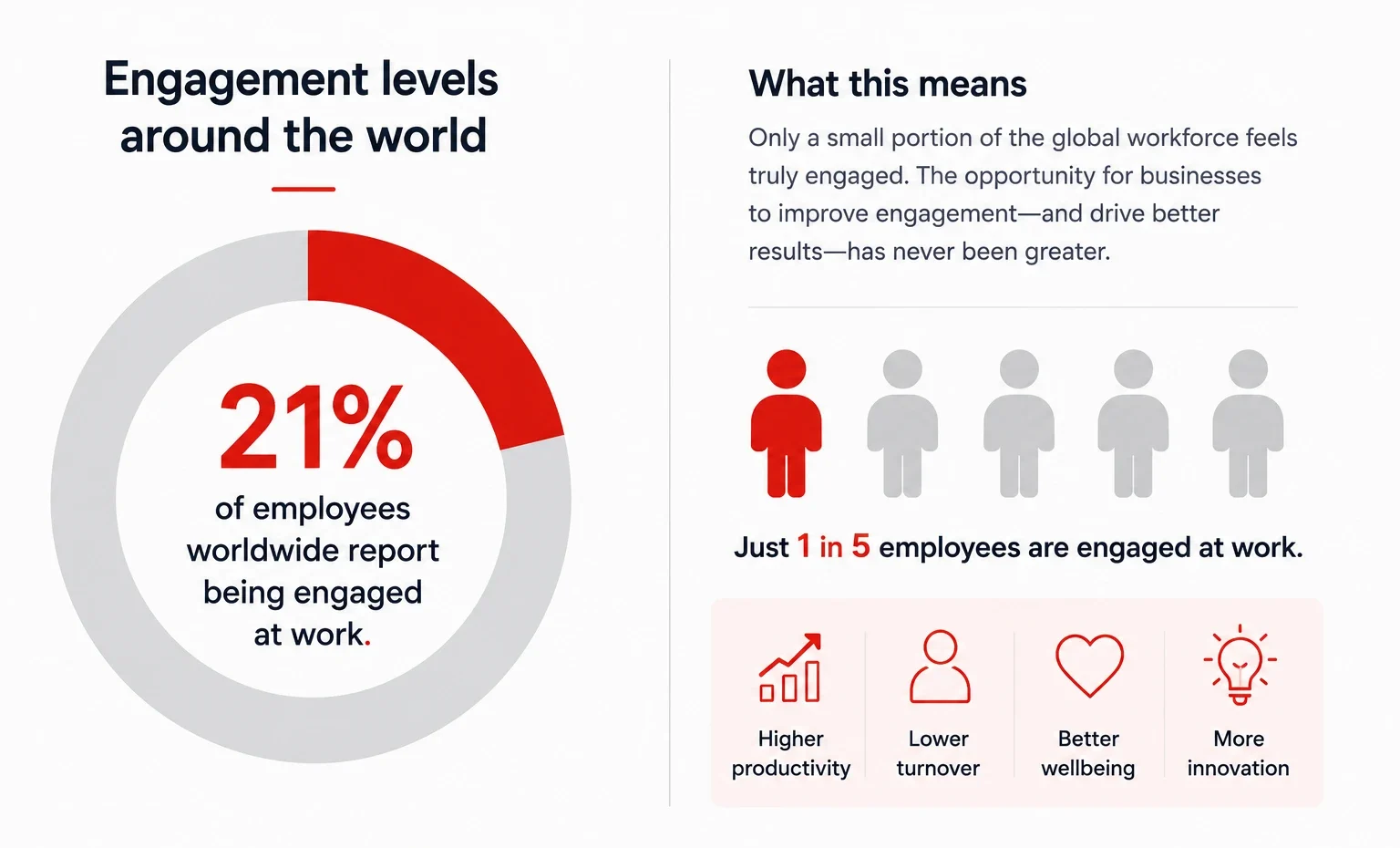
- Just 21% of employees worldwide report being engaged at work. [1]
-
- Highly engaged teams deliver up to 23% higher profitability compared to disengaged teams. [2]
-
- Disengaged employees cost UK businesses £340 billion each year through lost productivity and recruitment costs. [3]
-
- Just one disengaged employee typically costs an organisation 18% of their annual salary [4]
-
- Businesses with high levels of disengagement see up to 20% lower sales. [5]
-
- Engaged teams are 18% more productive than disengaged ones. [6]
-
- 90% of UK workers aren’t enthusiastic about their work. [5]
-
- 60% of UK staff are participating in quiet quitting. [5]
These stats make for stark reading: disengagement is widespread across UK organisations and profit margins are being hit as a result. The good news is that workforce engagement can be dramatically improved using proven, practical strategies. So it also presents an opportunity for savvy leaders to improve business results.
1. https://www.gallup.com/workplace/659279/global-engagement-falls-second-time-2009.aspx
2. https://www.qmarkets.net/resources/article/organizational-engagement/
3. https://www.rec.uk.com/our-view/news/news-our-business-partners/disengaged-employees-are-costing-businesses-fortune
4. https://julieallenconsulting.com/the-cost-of-disengaged-employees/
5. https://www.metateam.co.uk/news/the-hidden-cost-of-employee-disengagement-a-wake-up-call-for-businesses/
6. https://www.forbes.com/sites/nazbeheshti/2019/01/16/10-timely-statistics-about-the-connection-between-employee-engagement-and-wellness/
Engagement, Retention & Absenteeism Statistics
Highly engaged teams stay longer, require less frequent hiring, and cost less in onboarding and training. They also show much lower absenteeism rates, meaning fewer disruptions, better continuity, and improved capacity to meet targets.
-
- Organisations with strong engagement see 21%-51% lower turnover than those with weak engagement. [2]
-
- 96% of staff believe that showing empathy is an important way to increase employee retention. [6]
-
- Absenteeism is 78% lower in highly engaged organisations. [2]
-
- Disengaged employees have 37% higher absenteeism. [5]
Benchmarks like these provide clear evidence: improving engagement can directly reduce costly turnover. It also creates more stable teams and consistent outputs that drive results.
Beyond productivity and retention, engagement feeds organisational innovation. When employees feel connected and valued, they contribute more ideas, solve problems more creatively, and help organisations adapt faster. Organisations that lead in engagement often lead in market adaptability and new product development.
Benchmarking Drivers of Engagement
Now we’ve reviewed how engagement impacts business results, let’s look at the most impactful drivers behind it:
-
- Studies show that managers and leaders are a major driver of team engagement.
-
- Organisations that invest in leadership transparency and frequent manager check-ins report significantly higher engagement rates.
-
- Training and development opportunities are one of the top drivers of engagement, with a high percentage of employees citing career growth as motivational.
-
- Transparency, recognition, and consistent internal communication are major predictors of engagement (and useful benchmarking categories in their own right).
This highlights the importance of using benchmarks not only at the organisational level, but also at the team and managerial level. This enables HR teams and leaders to target interventions where they’ll have the most impact.