





Why Manager Recognition Matters More Than You Think
Managers occupy a difficult position in most organisations. They’re expected to translate leadership priorities into action, support employee performance, manage difficult conversations, maintain engagement and keep teams moving when workloads increase.
Yet recognition programmes often focus primarily on employees, leaving managers responsible for giving appreciation without receiving much themselves.
That matters because disengagement doesn’t stop with the individual manager. The way managers feel about their work can influence how they communicate, recognise, support and develop the people around them.
Manager Appreciation Day creates an opportunity to address this imbalance. But, as with employee appreciation, its real value comes from what happens throughout the rest of the year.
What Is Manager Appreciation Day?
Manager Appreciation Day is an opportunity to recognise the people responsible for leading and supporting teams.
It can involve gifts or team celebrations, but appreciation doesn’t need to be expensive or elaborate. A thoughtful message from a team, recognition from senior leadership or additional time away from work can all acknowledge the contribution a manager makes.
The important distinction is that the day recognises managers not simply for their job title, but for the work involved in managing people effectively.
Good management often happens quietly. Coaching employees, resolving conflicts, managing workloads, supporting development and protecting teams from unnecessary pressure may not produce highly visible achievements, but these activities can have a significant impact on the employee experience.
Manager Appreciation Day vs National Boss Day
Manager Appreciation Day and National Boss Day share a similar purpose, but the terminology reflects slightly different approaches.
National Boss Day — often called Boss’s Day — is traditionally associated with employees showing appreciation for their boss. Manager Appreciation Day is a broader concept that can be incorporated into an organisation’s recognition strategy and extended across different management levels.
For modern workplaces, the second approach can feel more relevant.
A “boss” implies hierarchy, whereas managers and team leaders increasingly work as coaches, facilitators and sources of support. Recognising effective management therefore means acknowledging how leaders enable other people to succeed, rather than simply celebrating seniority.
When Is Boss Day in the UK?
National Boss Day is traditionally observed on 16 October each year. Unlike established UK public or bank holidays, however, it isn’t an official national observance employers are expected to celebrate.
UK organisations therefore don’t need to structure manager recognition around a particular calendar date.
Some businesses may choose 16 October as a convenient moment to celebrate their managers, while others can create their own Manager Appreciation Day or incorporate leadership recognition into a broader employee recognition programme.
The date is less important than the quality and consistency of the appreciation.
Why Managers Are the Forgotten Middle
Managers are frequently responsible for delivering initiatives designed by senior leadership while simultaneously responding to the needs of employees.
That creates pressure from both directions.
They may be responsible for engagement, performance, wellbeing, recognition, development and retention within their teams while also managing their own objectives and workload.
Recent Gallup data illustrates why this deserves attention. Global manager engagement has fallen from 32% in 2022 to 22% in 2025, a nine-point decline. In 2025 alone, it fell five percentage points.
Managers cannot be expected to create highly engaged teams indefinitely if their own experience of work is being overlooked.
Why Recognising Managers Matters
Manager recognition is sometimes uncomfortable for organisations.
Employees are expected to receive appreciation from their managers, but reversing that relationship can feel less natural. There can also be concern that recognising managers takes attention away from their teams.

In reality, the two are connected.
Recognition shouldn’t operate in only one direction. A healthy workplace culture allows appreciation to move between colleagues, from managers to employees, from employees to managers and from senior leadership throughout the organisation.
The Manager’s Impact on Team Engagement
Managers influence many of the everyday experiences that determine how employees feel about work.
They allocate responsibilities, communicate priorities, provide feedback, manage performance and respond when employees encounter problems. They also play a central role in recognition itself.
Gallup’s wider engagement research consistently identifies managers as an important influence on team engagement. Its 2025 report also found that management training can have effects beyond managers themselves: participants in one manager training programme recorded up to 22% higher engagement, while engagement among their teams increased by up to 18%.
Recognising managers isn’t therefore about placing managers above their teams.
It’s about acknowledging that the employee experience is partly shaped by the people responsible for leading those teams.
Manager Burnout and Its Ripple Effect
Managers don’t leave stress at the door when they begin a team meeting.
High workloads, difficult decisions and constant responsibility for other people can contribute to exhaustion. When that pressure continues for long periods, managers may have less capacity for coaching, communication and recognition.
The wider cost of poor workplace mental health is significant. Deloitte estimates that poor mental health costs UK employers around £51 billion per year, with presenteeism accounting for approximately £24 billion. Its research also found that 63% of surveyed working adults experienced at least one characteristic of burnout.
Those figures cover the wider workforce rather than managers specifically, so they shouldn’t be presented as evidence of manager burnout alone. They do, however, illustrate the business impact of failing to support wellbeing at work.
Managers need to be included in that support rather than treated exclusively as the people responsible for delivering it.
Why Recognition Should Flow Upwards Too
Most traditional recognition follows the organisational hierarchy.
Managers recognise employees. Directors recognise managers. Senior executives may receive acknowledgement from the board.
Peer-to-peer recognition challenges that model by allowing appreciation to travel across teams and organisational levels.
Employees are often particularly well placed to recognise good management because they experience its effects directly.
They know when a manager made time to support them during a difficult project, provided useful feedback, protected the team from unrealistic expectations or helped someone develop their career.
Giving employees access to peer-to-peer recognition software can make these contributions more visible while encouraging appreciation to flow in more than one direction.
The Cost of Overlooking Your Managers
Manager disengagement rarely exists in isolation.
A disengaged employee affects their own role. A disengaged manager potentially influences an entire team.
When managers feel consistently overlooked, their motivation can decline. Communication may become more transactional, recognition less frequent and development conversations easier to postpone.
Over time, these changes can affect the employee experience.
There is also a retention consideration. Experienced managers hold organisational knowledge, understand team dynamics and often maintain important relationships across departments. Losing them can create disruption beyond the cost of replacing one individual.
This is one reason why employee engagement matters at every level of an organisation rather than only among individual contributors.
Supporting managers through training, wellbeing initiatives and meaningful recognition helps protect the infrastructure that supports wider team performance.

How to Recognise Your Managers Meaningfully
Manager appreciation works best when it acknowledges what someone actually contributes.
A generic “Happy Boss Day” message may be well intentioned, but it says very little about why that manager is valued.
Make It Personal and Specific
Specific recognition has greater meaning because it connects appreciation to real behaviour.
Rather than telling a manager they’re doing a “great job”, identify what makes their management valuable.
Perhaps they successfully guided a team through organisational change. Maybe they helped develop several employees into more senior positions. They might consistently create space for people to raise concerns or be particularly effective at recognising their team’s contributions.
Specific examples turn a polite gesture into meaningful feedback.
Recognition From Leadership and From the Team
Managers should ideally receive recognition from both directions.
Senior leaders can acknowledge performance, leadership and contribution to wider business objectives. Team members can provide a different perspective by recognising how the manager supports their everyday working experience.
Combining the two provides a more complete picture.
A team message or collection of individual notes can be particularly effective because it allows employees to describe the manager’s impact in their own words.
For significant achievements, senior leadership can reinforce that appreciation through public recognition or a personal message.
Rewards That Respect a Manager’s Time and Seniority
Not every manager needs or wants another physical gift.
For people with demanding schedules, time can be particularly valuable. Additional annual leave, a flexible afternoon, a wellbeing experience or an opportunity to disconnect from work may be more meaningful than traditional merchandise.
When tangible rewards are appropriate, flexibility matters.
An employee rewards programme can allow managers to select rewards based on their own preferences rather than receiving a generic item chosen on their behalf.
The value doesn’t necessarily need to be higher because the recipient is a manager. It should instead be proportionate to the achievement and consistent with the organisation’s wider recognition approach.
Manager Appreciation Ideas That Go Beyond a Gift
The strongest manager appreciation ideas combine a gesture with a clear explanation of why the person is being recognised.
That leaves organisations with plenty of options beyond buying another mug or desk accessory.
Low-Cost Ways to Recognise Managers
Recognition can be meaningful without requiring a significant budget.
A team can create a collection of personal thank-you messages describing specific moments when their manager helped them. Senior leaders can recognise strong managers during company meetings or internal communications.
Other ideas include giving managers additional flexibility, arranging a team lunch, creating an appreciation video from colleagues or providing development opportunities connected to their career ambitions.
Teams can also recognise managers for particular strengths — coaching, communication, empathy or leadership during challenging periods — rather than presenting generic “best boss” awards.
These forms of non-financial recognition can feel particularly authentic because the emphasis remains on the contribution rather than the monetary value.
Premium Rewards and Experiences
For significant achievements or milestones, organisations may want to provide something more substantial.
Restaurant experiences, travel, wellbeing activities, event tickets or flexible gift cards allow managers to enjoy something outside work.
A wider selection of types of rewards for staff can also help organisations move beyond traditional corporate gifts and choose something appropriate for different preferences.
Experiences can be particularly effective because they create separation from work. A manager who spends most of their time looking after a team may appreciate a reward designed entirely around their own interests.
Ideas for Remote and Hybrid Managers
Recognition can become less visible when managers and their teams don’t regularly share the same workplace.
Remote managers may also invest considerable effort in maintaining communication and team culture without those contributions being immediately obvious.
Digital recognition helps overcome that distance.
Teams can coordinate video messages, virtual celebrations or online recognition posts. Flexible digital rewards can be delivered regardless of location, while senior leaders can recognise remote managers during company-wide calls.
The principle is the same as for a Staff Appreciation Day: location shouldn’t determine whether someone’s contribution is noticed.
Boss Day Gift Ideas UK Managers Actually Want
If your organisation does choose to mark National Boss Day with a gift, avoid assuming every manager wants the same thing.
Food and restaurant experiences can work well for some people. Others may prefer travel, entertainment, technology, wellbeing or something they can share with their family.
Flexible gift cards reduce the risk of choosing incorrectly, while additional leave or experiences offer alternatives to physical products.
Personalisation should extend to the message accompanying the gift.
A £100 reward with no explanation can feel more transactional than a smaller gift accompanied by genuine recognition from the team.
The best Boss Day gift is therefore not necessarily the most expensive. It’s one that reflects the individual and is supported by authentic appreciation.
Building a Culture That Recognises Leaders Year-Round
A manager shouldn’t need to wait until October to discover whether their team and organisation value their contribution.
Recognition needs to become part of the management experience throughout the year.
That means including managers in company recognition programmes rather than positioning them exclusively as administrators of those programmes. They should be able to receive peer recognition, celebrate milestones and access meaningful rewards in the same way as other employees.
Gifteo’s solution for managers and team leads to increase motivation helps managers recognise their teams while making recognition easier to embed into everyday work.
But the wider principle applies in both directions.
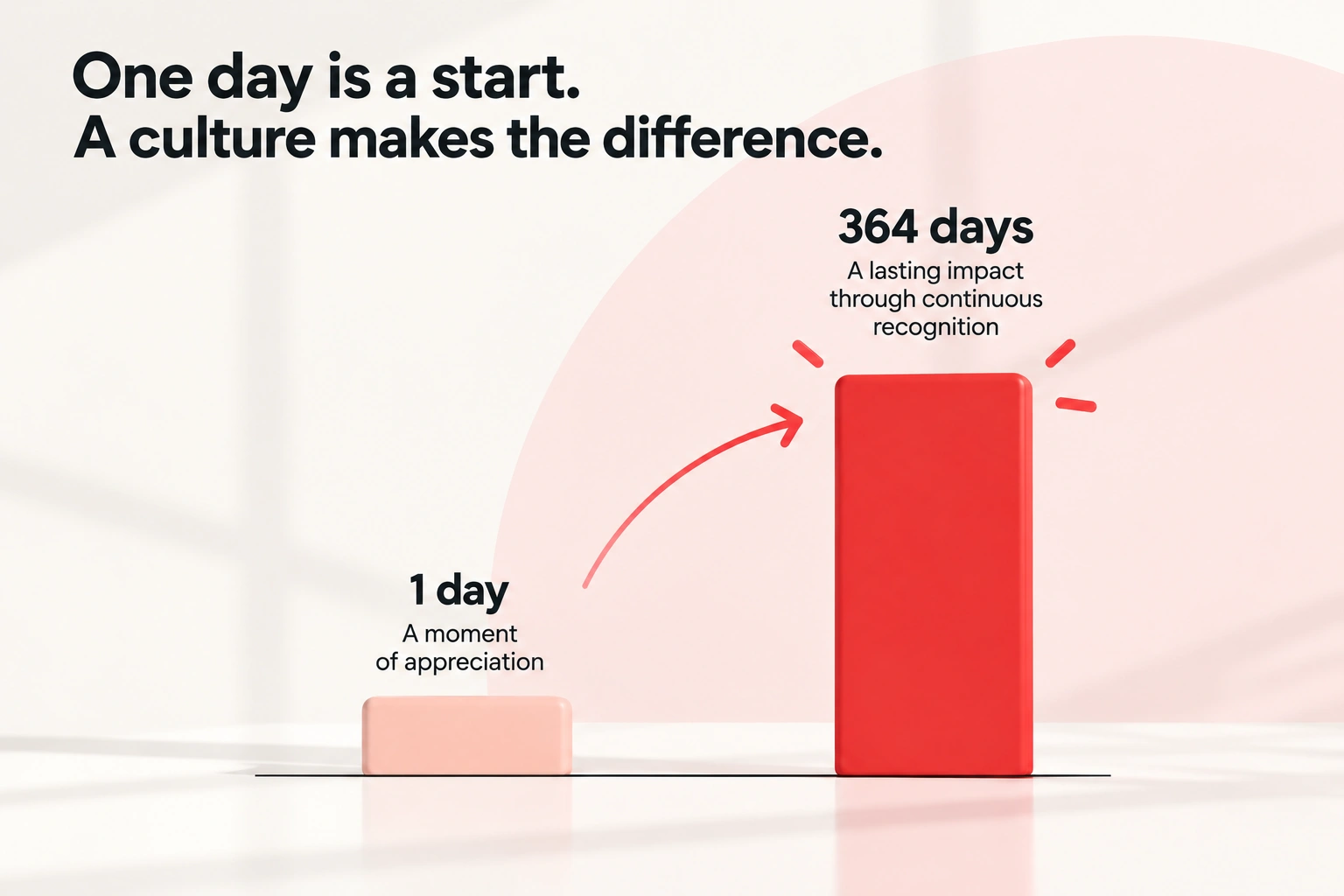
When appreciation moves freely between employees, managers and senior leaders, recognition becomes part of company culture rather than an annual event.
How to Measure the Impact on Team Performance
Manager appreciation shouldn’t be judged by how many gifts were distributed.
Start by looking at whether managers actually feel recognised. Engagement surveys and pulse surveys can include questions around appreciation, leadership support, workload and wellbeing.
Participation can also provide useful signals. Are teams recognising their managers? Are senior leaders participating? Is recognition distributed across management levels, departments and locations?
Over time, organisations can compare these indicators with manager retention, absence, engagement and wider team results.
Correlation should not automatically be treated as causation. Manager recognition is only one part of the employee experience, alongside workload, compensation, development, leadership quality and organisational culture.
The objective is therefore not to prove that one Manager Appreciation Day transformed performance.
It’s to ensure the people responsible for motivating, supporting and recognising everyone else aren’t forgotten in the process.v