





Building an Employee Benefits Scheme That Employees Actually Value
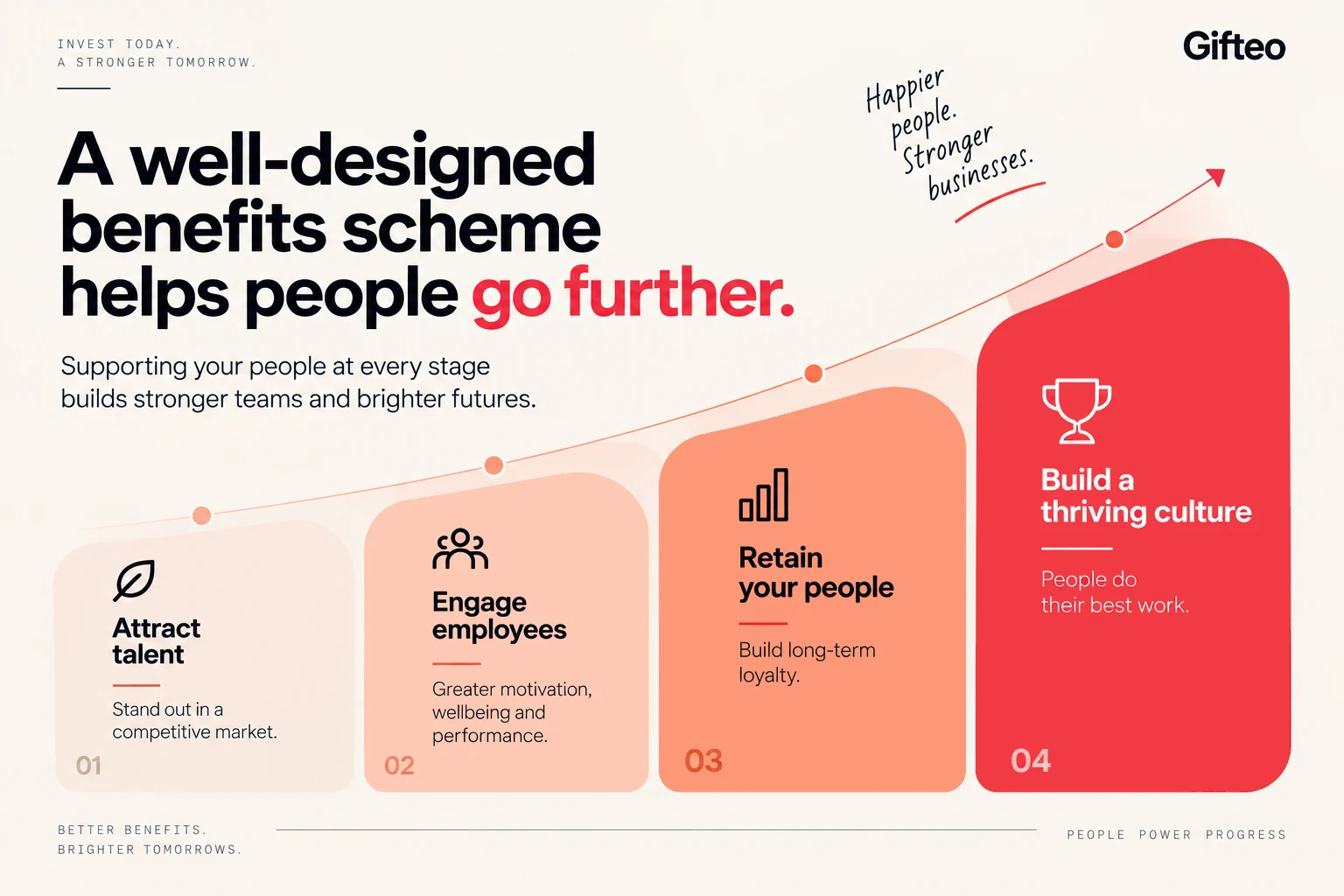
Employee benefits have become an important part of the overall employment package. Salary still matters, but employees increasingly evaluate an employer through the wider experience it provides — from pensions and wellbeing support to flexible benefits, everyday savings and recognition.
Yet offering more benefits doesn’t automatically create more value.
Organisations can invest in extensive employee benefits packages only to discover that employees don’t know what’s available, don’t understand how to access it or simply don’t value some of the perks being offered.
The challenge for employers is therefore not to build the longest possible list of benefits. It’s to create an employee benefit scheme that responds to genuine workforce needs, supports business objectives and delivers enough everyday value for employees to actually use it.
What Is an Employee Benefits Scheme?
An employee benefits scheme is the collection of benefits an organisation provides in addition to an employee’s basic salary.
Some benefits are required by law, while others are introduced voluntarily by employers. Depending on the organisation, a package might include workplace pensions, additional annual leave, private medical insurance, wellbeing support, employee discounts, salary sacrifice schemes, recognition or lifestyle benefits.
The precise combination varies significantly between employers.
What matters is how these individual benefits work together. A strong benefits package isn’t simply a collection of unrelated perks. It should support the organisation’s wider approach to reward, wellbeing and the employee experience.
Benefits vs Perks vs Rewards
Benefits, perks and rewards are closely related, but they aren’t necessarily the same thing.
Employee benefits usually form part of the wider employment package. Pension contributions, healthcare support, enhanced parental leave and wellbeing programmes are common examples.
Employee perks tend to be additional advantages associated with working for an organisation. These could include free food, gym discounts, flexible working arrangements or access to entertainment and retail savings.
Employee rewards, meanwhile, are generally connected with recognition, achievement or particular behaviours. A manager might give an employee a gift card after exceptional work, for example, while the same employee has access to healthcare and discounts as ongoing benefits.
The boundaries can overlap. What’s more important is that employees understand what they have access to and why each element exists.
Core, Voluntary and Flexible Benefits
Benefits can also be grouped according to how employees access them.
Core benefits are provided to eligible employees as part of their employment package. These can include statutory entitlements alongside employer-funded benefits such as enhanced pension contributions or life insurance.
Voluntary benefits are made available by the employer but may be funded partly or entirely by the employee, often with access to preferential rates or terms.
Flexible benefits give employees greater choice over their package.
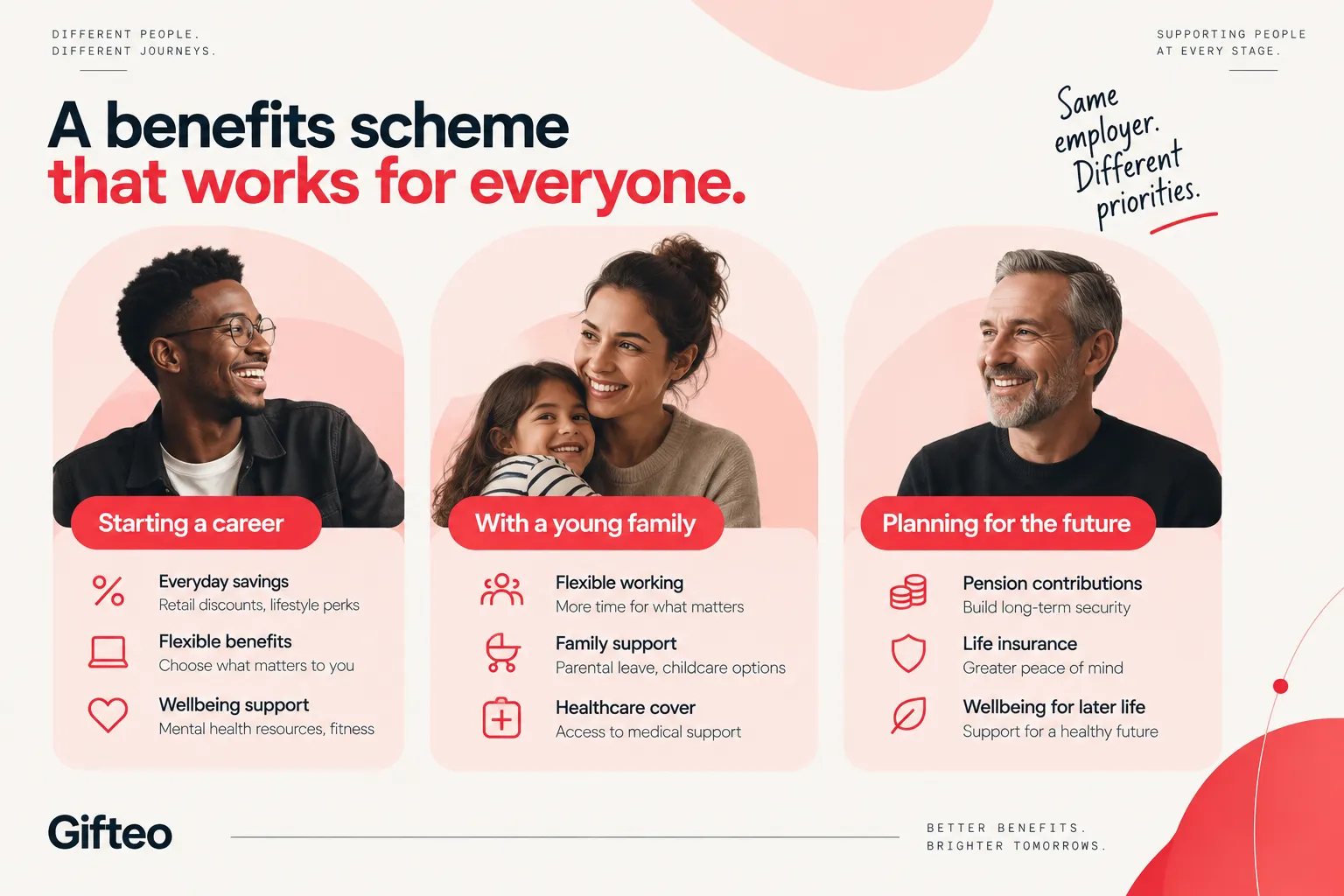
This flexibility is increasingly relevant because a workforce rarely has one universal set of priorities. Someone starting their career may value everyday savings differently from an employee with children, while another employee may place greater importance on healthcare, pension contributions or wellbeing.
A well-designed scheme recognises these differences rather than assuming one package will work equally well for everyone.
Types of Employee Benefit Schemes in the UK
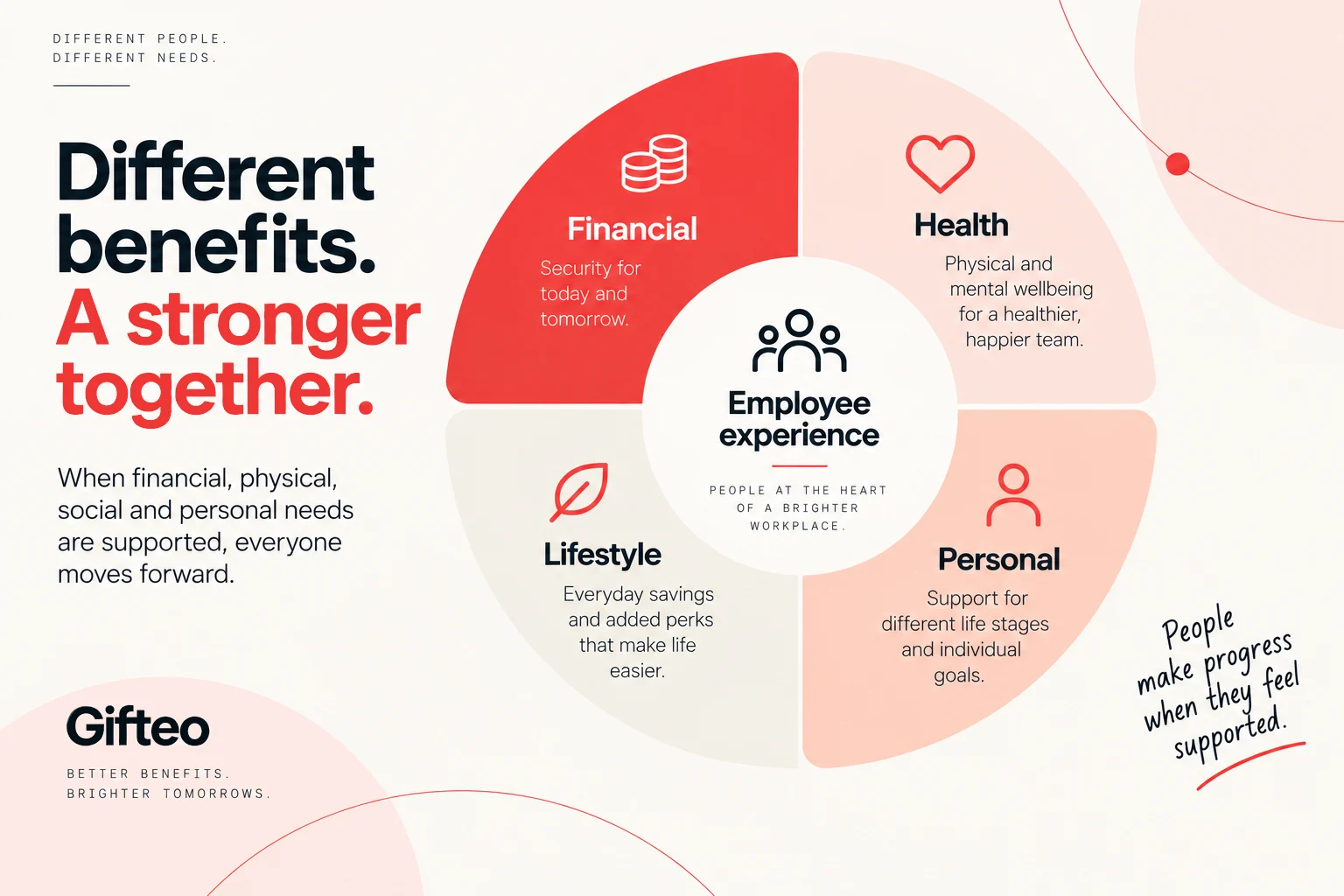
There is no single formula for the ideal employee benefits package.
The right combination depends on workforce demographics, business objectives, available budget and what employees actually value.
Most schemes draw from several broad categories.
Salary Sacrifice Schemes
Salary sacrifice allows an employee to give up part of their cash salary in exchange for a non-cash benefit provided by their employer.
The tax treatment depends on the benefit involved. Some arrangements can retain tax and National Insurance advantages, while others are subject to the UK’s optional remuneration rules.
Common arrangements can include pension contributions and certain schemes such as Cycle to Work.
For employers, salary sacrifice can make particular benefits more accessible without simply adding their full retail cost to the benefits budget. However, arrangements need to be structured correctly, communicated clearly and considered alongside issues such as National Minimum Wage requirements.
Health and Wellbeing Schemes
Employee wellbeing extends beyond physical health.
Modern programmes can include mental health support, Employee Assistance Programmes, counselling, healthcare services, fitness initiatives and preventative wellbeing resources.
Effective employee wellness programmes should reflect the needs of the workforce rather than existing simply because wellbeing has become a common component of benefits packages.
Accessibility is particularly important.
A wellbeing programme has limited value when employees don’t know it exists, are uncertain whether support is confidential or face unnecessary friction when trying to use it.
Employers should therefore consider both the quality of the benefit and the employee journey required to access it.
Financial and Pension Schemes
Financial wellbeing has become another important part of the benefits conversation.
Workplace pensions are an obvious component, but employers can also provide financial education, salary sacrifice arrangements and tools that help employees manage everyday costs.
This is where employee savings benefits can complement longer-term financial support.
Discounts on groceries, travel, technology, entertainment and other regular expenses may not appear as substantial as a pension contribution, but their impact is immediate and visible.
That distinction matters. Employees need support for their future financial security, but many also value benefits that improve purchasing power today.
Lifestyle, Discount and Recognition Schemes
Lifestyle benefits broaden the package beyond traditional pension and healthcare provision.
An employee discount programme can provide savings across retailers, leisure, travel and everyday spending. Recognition schemes can acknowledge achievements or milestones, while flexible rewards allow employees to choose something personally relevant.
These benefits can increase the visibility of the overall package because employees may interact with them considerably more frequently than with benefits such as insurance.
That regular interaction can help demonstrate the value of working for the organisation throughout the year rather than only when a specific life event occurs.
How Much Do Employee Benefit Schemes Cost?
There is no universal cost per employee.
A basic discount or recognition programme will have a very different cost structure from a package containing private medical insurance, enhanced pension contributions and substantial salary sacrifice benefits.
The more useful question is whether the money being spent produces value for employees and supports the organisation’s objectives.
Typical Cost per Employee
Employers should calculate the total cost of the scheme and then understand how that investment is distributed across the workforce.
This can include:
- provider or platform fees;
- employer pension contributions;
- insurance premiums;
- reward budgets;
- wellbeing services;
- administration costs;
- internal HR resource.
Cost per employee provides a useful baseline, but it shouldn’t be considered alone.
A £100 benefit that employees use frequently may deliver greater perceived value than a £500 benefit with extremely low take-up.
Usage therefore needs to sit alongside cost when evaluating the package.
Tax Treatment and Salary Sacrifice Savings
Not every employee benefit is taxed in the same way.
Some benefits are taxable benefits in kind, while exemptions or specific tax treatment apply to others. Salary sacrifice introduces another layer because tax and National Insurance treatment depends on the benefit being exchanged for salary.
Employers should therefore check current HMRC guidance on expenses and benefits when designing or changing a scheme.
Tax efficiency can improve the economics of particular benefits, but it shouldn’t be the only reason for offering them.
A tax-efficient benefit employees don’t want is still unlikely to create much perceived value.
Reporting Obligations: P11D and Payroll
Depending on the benefit and how it is provided, employers may also have reporting and payroll obligations.
Taxable benefits may need to be reported to HMRC, either through the appropriate benefits reporting process or through payroll where benefits are payrolled.
Employers should identify these obligations when selecting benefits rather than treating administration as an afterthought.
The exact treatment varies according to the benefit, which makes current HMRC guidance important when building the package.

What UK Employers Get Wrong About Benefit Schemes
One of the clearest problems with employee benefits isn’t necessarily a lack of investment. It’s a lack of strategy.
Recent CIPD research found that 22% of UK employers had no clear objectives for their employee benefits, while retention and engagement were among the most common objectives for organisations that did connect benefits with specific outcomes.
CIPD research on employee benefit objectives
Without a clear purpose, organisations risk accumulating benefits without understanding whether they’re solving a meaningful problem.
Running a Scheme With No Clear Objective
Every major benefit should answer a question.
What workforce need does it address? What business objective does it support? How will the organisation know whether it’s working?
An employer concerned about financial pressure might prioritise everyday savings and financial wellbeing. An organisation experiencing retention problems might look more broadly at reward, recognition, flexibility and development.
Objectives don’t mean every benefit needs to produce a direct financial return.
They simply provide a reason for the investment and a basis for measuring whether it remains relevant.
Choosing Perks Employees Don’t Use
A benefit isn’t valuable simply because it looks attractive in a recruitment brochure.
Gym memberships may appeal strongly to part of the workforce and be irrelevant to others. Office-based perks provide little value to fully remote employees. A fixed retail voucher may be less useful than flexible spending options.
Assumptions are expensive.
Employee surveys, benefits usage data and demographic information can all help organisations understand what people value before committing budget.
Choice can also reduce this problem by allowing employees to access benefits that fit their own circumstances.
Poor Communication and Low Take-Up
Even an excellent package can underperform when employees don’t understand it.
Benefits are often explained during onboarding and then barely mentioned again. Months later, employees may remember that a programme exists without knowing what it includes or how to access it.
Communication should therefore continue throughout the employee lifecycle.
Use onboarding, internal newsletters, manager communications, payslips, benefits portals and relevant moments throughout the year to remind employees what’s available.
Keep the message practical.
Instead of saying “you have access to our employee benefits platform”, show employees what they can actually do with it: save money on weekly shopping, access wellbeing support or claim a reward.
Treating Benefits as a Cost, Not an Investment
Benefits obviously have a cost.
But evaluating them exclusively through expenditure can miss their role in recruitment, retention, wellbeing and engagement.
This doesn’t mean every benefit generates positive ROI. Employers should be prepared to remove programmes that employees don’t value or use.
The distinction is between asking “How much does this cost?” and asking “What value are we getting for this cost?”
Understanding the wider benefits for employers helps HR teams connect their package with outcomes such as attraction, retention, engagement and productivity rather than treating benefits purely as an administrative expense.
How to Design an Employee Benefits Scheme That Works
An effective scheme starts with the workforce rather than the provider catalogue.
Technology matters, but only after the organisation understands what it’s trying to achieve.
Start With Objectives and Audience
Begin with existing people challenges.
Are employees experiencing financial pressure? Is retention declining? Does the organisation need to strengthen wellbeing support? Are current benefits underused?
Then examine the workforce itself.
Employee surveys, exit interviews, engagement data and current usage can help identify gaps between what the organisation provides and what employees value.
This prevents the benefits strategy from becoming a collection of assumptions made by HR or senior leadership.
Segment for a Multi-Generational Workforce
Different employees are likely to value different things, although employers should avoid simplistic assumptions based solely on age.
Life circumstances are often more useful.
Employees may be renting or buying a home, raising children, caring for relatives, approaching retirement or simply prioritising experiences and flexibility differently.
A flexible package allows employees to select benefits relevant to their circumstances without requiring HR to design an entirely separate programme for every demographic group.
The objective isn’t to predict what each generation wants. It’s to provide enough relevant choice that employees can decide for themselves.
Choosing an Employee Benefits Platform or Provider
The platform determines how easily employees discover and access their benefits.
Look beyond the number of benefits listed in a provider’s catalogue.
Consider usability, mobile access, integrations, reporting, reward flexibility, communication tools and the amount of administration required from HR.
The employee experience matters as much as the feature list. If employees need several logins or complicated processes to claim a simple benefit, usage is likely to suffer.
The same principles apply when choosing an employee reward platform: technology should make participation easier rather than creating another system employees need to understand.
Budgeting and Measuring ROI
Set the budget around objectives rather than simply copying what comparable organisations spend.
Then measure several dimensions of performance.
Take-up rates show whether employees use the scheme. Engagement surveys can indicate perceived value. Recruitment feedback can reveal whether benefits influence candidates, while retention data may identify longer-term patterns.
Savings generated for employees can also be measured for certain benefits.
ROI doesn’t always need to be reduced to a single monetary figure. A balanced assessment can combine cost, usage, employee feedback and relevant people metrics.
How to Communicate Your Scheme and Drive Take-Up
Launching a benefits platform isn’t the end of implementation.
Employees need repeated reasons to return.
Communication should explain benefits in terms of situations employees recognise. A discount programme becomes more relevant when employees see how much they could save on everyday spending. An EAP becomes easier to understand when people know what support is available and how confidentiality works.
Managers can also play an important role by signposting benefits when relevant, provided they understand the package themselves.
Seasonal communication can create additional touchpoints: financial wellbeing at the start of the year, travel and leisure benefits before summer, wellbeing support during stressful periods and savings around major spending occasions.
Most importantly, make access simple.
Every additional step between an employee and a benefit creates another opportunity for them to abandon the process.

Employee Benefit Scheme Examples
The strongest employee benefits packages usually combine different types of support rather than relying on one category.
A balanced scheme might include a workplace pension and enhanced leave as core benefits, healthcare or an Employee Assistance Programme for wellbeing, salary sacrifice options where appropriate and everyday discounts to support financial wellbeing.
Recognition and flexible rewards can sit alongside these benefits to acknowledge employee contributions and milestones.
A larger organisation might provide extensive choice through a flexible benefits platform, while a smaller employer could focus its budget on a narrower selection of benefits with high relevance and usage.
There is no single “best” package.
A successful scheme is one that employees understand, can access easily and consider relevant to their lives.
Making Employee Benefits More Valuable
The employee benefits market gives employers an enormous number of options. The challenge is no longer finding benefits to offer.
It’s deciding which ones deserve investment.
Gifteo brings employee discounts, savings, rewards, recognition and wellbeing benefits together within a single employee engagement platform. This gives employees easier access to benefits they can use throughout the year while giving HR teams greater visibility over participation and engagement.
But technology alone won’t fix a poorly designed benefits strategy.
Start with clear objectives. Understand your workforce. Select benefits that solve real problems. Communicate them repeatedly. Then use participation and employee feedback to keep improving the package.
The objective isn’t to offer employees everything.
It’s to make the benefits you do offer genuinely worth having.