





Understanding Employee Recognition and Why It Matters
Employee recognition has become a central part of how organisations engage, motivate, and retain their people. But effective recognition involves more than occasional praise or an annual awards ceremony. Employees need to feel that their everyday contributions are noticed, valued, and connected to the wider success of the organisation.
For UK employers, that means building recognition into the employee experience rather than treating it as an isolated HR initiative. From a simple thank you to peer-to-peer recognition and structured reward programmes, the right approach can strengthen workplace culture while supporting engagement, retention, and performance.
This guide explores what employee recognition means, what good recognition looks like, the different programmes businesses can use, and practical employee recognition ideas that work across modern workplaces.
What Is Employee Recognition?
Employee recognition is the act of acknowledging an employee’s contribution, achievement, behaviour, or impact at work. It can be as simple as a manager thanking someone for handling a difficult project or as structured as a company-wide recognition programme with nominations, points, awards, and rewards.
The purpose is to make employees feel that their work matters.
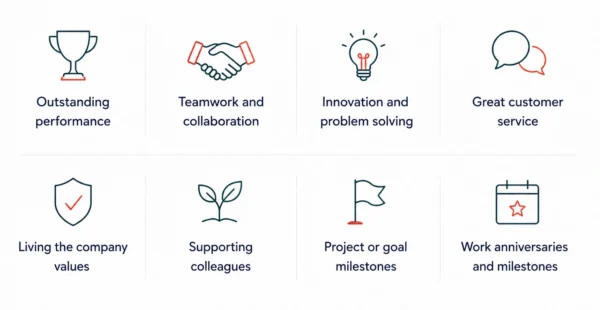
Recognition can celebrate exceptional performance, but it shouldn’t be limited to major achievements. Everyday contributions, teamwork, customer service, innovation, demonstrating company values, supporting colleagues, and reaching career milestones can all be recognised.
This distinction matters because employees contribute value in different ways. A recognition culture that celebrates only the highest performers risks overlooking the people whose consistent work keeps teams and organisations moving forward.
Recognition vs Rewards vs Appreciation
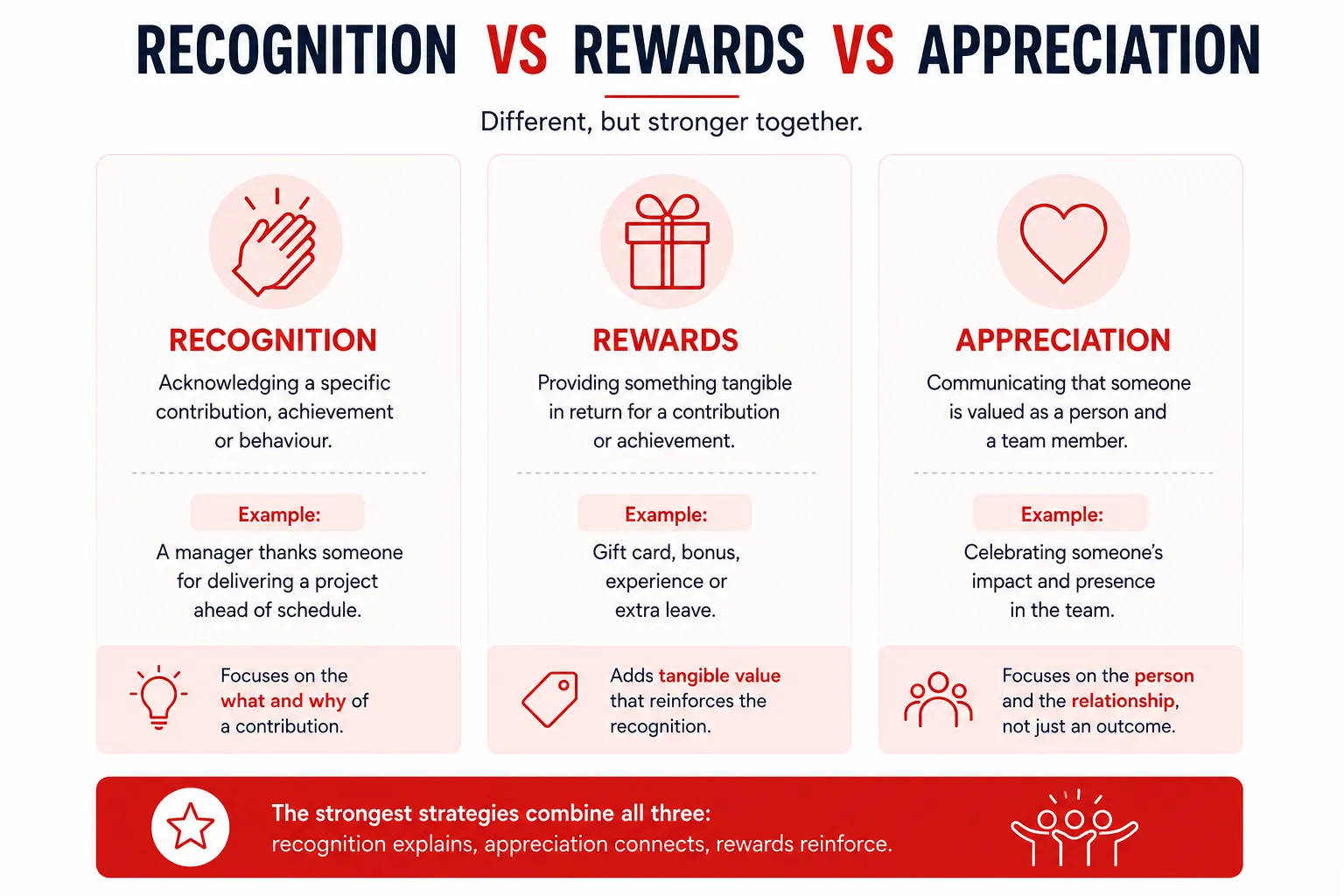
Recognition, rewards, and appreciation are closely connected, but they aren’t exactly the same.
Employee recognition acknowledges a specific contribution, achievement, or behaviour. A manager might recognise someone for delivering an important project ahead of schedule, for example.
Employee rewards provide something tangible in return for a contribution or achievement. This could include a gift card, experience, bonus, additional leave, or another benefit.
Employee appreciation is broader. It communicates that someone is valued as a person and member of the organisation, rather than recognising one particular achievement.
The strongest strategies combine all three. Recognition explains why someone’s contribution matters, appreciation reinforces their value to the organisation, and rewards can add something tangible to the experience.
Types of Recognition: Formal, Informal, Peer-to-Peer and Top-Down
Recognition can take several forms, and effective organisations rarely rely on just one.
Formal recognition includes structured initiatives such as annual awards, employee-of-the-month schemes, long service awards, or performance-related recognition. These programmes provide consistency and make significant achievements visible across the organisation.
Informal recognition happens naturally during everyday work. A thank-you message after a difficult meeting, public praise during a team call, or a manager acknowledging someone’s extra effort can all have an immediate impact.
Recognition can also be top-down, coming from managers and senior leaders, or peer-to-peer, where employees recognise colleagues directly.
Peer recognition is particularly valuable because managers don’t see every contribution. Giving employees the ability to acknowledge one another makes recognition more inclusive and helps appreciation become part of everyday workplace culture.
Intrinsic vs Extrinsic Recognition
Not every recognition moment needs a financial reward.
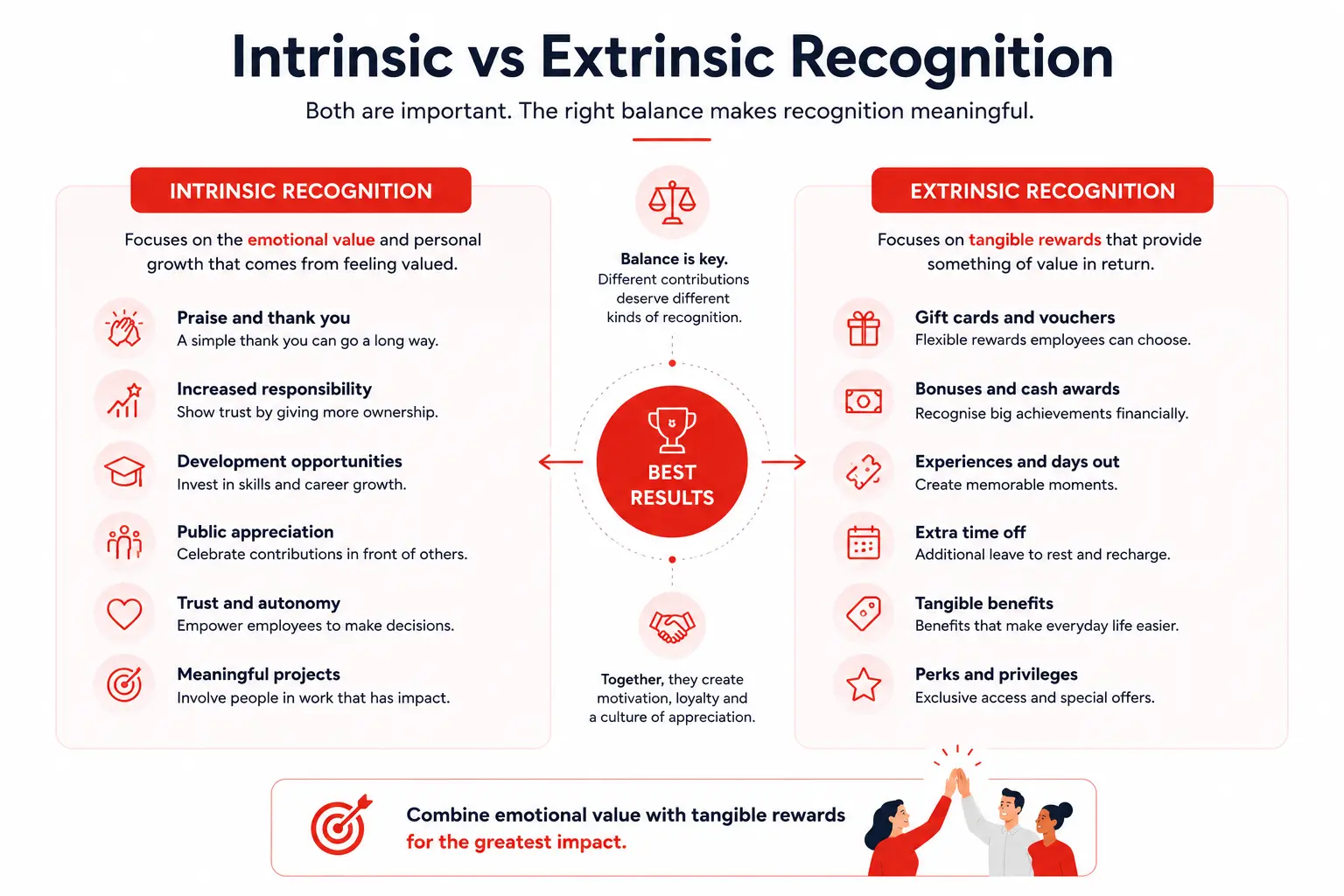
Intrinsic recognition focuses on the emotional value of being acknowledged. Praise, increased responsibility, development opportunities, public appreciation, or simply being trusted to contribute to an important project can all provide intrinsic value.
Extrinsic recognition includes tangible rewards such as gift cards, bonuses, experiences, or additional benefits.
The two approaches work best together. A gift without meaningful feedback can feel transactional, while praise without tangible recognition may not always feel sufficient for major achievements.
Understanding the difference helps organisations build recognition experiences that feel proportionate to the contribution being recognised.
Why Employee Recognition Matters for UK Employers
Recognition might appear simple, but its impact extends into several important business outcomes.
The CIPD recommends embedding employee recognition within the wider reward strategy while ensuring that recognition remains authentic and aligned with organisational values. Its evidence review on incentives and recognition also highlights the importance of designing rewards around the realities of individual roles and teams and ensuring schemes are perceived as fair.
For employers, the challenge is therefore not simply to provide more recognition. It’s to make recognition meaningful, consistent, and relevant.
The Link Between Recognition and Retention
Employees are more likely to question their future with an organisation when their contribution repeatedly goes unnoticed.
Research from Gallup and Workhuman followed nearly 3,500 employees between 2022 and 2024 and found that well-recognised employees were 45% less likely to have changed organisations two years later. Employees receiving high-quality recognition were also significantly less likely to be actively looking for another opportunity.
This makes recognition an important part of a broader retention strategy.
Employees still leave organisations for many reasons, including salary, career progression, leadership, flexibility, and personal circumstances. Recognition cannot compensate for fundamental problems in the employee experience.
However, when employees are doing good work but rarely receive meaningful feedback or appreciation, businesses create an avoidable reason for disengagement.
Recognition, Engagement and Productivity
Good recognition tells employees that their contribution matters and shows them which behaviours the organisation values.
This connection can reinforce motivation and provide greater clarity around what good performance looks like. Gallup’s research has found that employees who strongly agree they receive the right amount of recognition are four times as likely to be engaged at work.
Recognition can also have an impact beyond the person receiving it.
When achievements are shared publicly, colleagues see examples of the behaviours, contributions, and values the organisation wants to encourage. Recognition therefore becomes both an individual experience and a cultural signal.
For organisations looking to improve employee engagement in the workplace, this makes recognition a practical tool for connecting individual contributions with wider business goals.
The Cost of Getting Recognition Wrong
Poor recognition doesn’t necessarily mean providing no recognition at all.
Generic, inconsistent, unfair, or delayed recognition can also undermine a programme. If the same people are repeatedly recognised, managers apply different standards, or rewards appear disconnected from genuine contributions, employees may question the credibility of the entire initiative.
The financial impact of losing engaged employees can also be significant. Gallup estimates that replacement costs can vary substantially by role, reaching around 40% of salary for frontline employees, 80% for technical roles, and approximately 200% for leaders and managers.
Getting recognition right is therefore not simply about creating positive moments. It can form part of a wider strategy to protect experience, knowledge, engagement, and organisational stability.

What Does Good Employee Recognition Look Like?
The amount of recognition employees receive matters, but quality is just as important.
A quick “good job” can be positive, but recognition becomes more meaningful when employees understand exactly what they did well and why it mattered.
The Pillars of High-Quality Recognition
High-quality recognition should feel relevant to the person receiving it and proportionate to their contribution.
Gallup and Workhuman identify five pillars within strategic recognition: it should be fulfilling, authentic, equitable, embedded in culture, and personalised. Their research suggests that recognition satisfying several of these characteristics is associated with substantially stronger employee engagement.
In practical terms, recognition should answer three questions:
What did the employee do?
Why did it matter?
Why is the organisation recognising it?
This gives recognition context and makes it easier for both the employee and their colleagues to understand its value.
Timely, Specific and Authentic
Recognition is generally most effective when it happens close to the achievement.
Waiting several months to mention someone’s contribution during an annual review reduces the connection between the behaviour and the recognition. Managers should instead acknowledge meaningful work while it is still relevant.
Specificity matters too.
“Great work” is positive, but “Your work resolving that customer issue helped us retain an important account” explains exactly what was valuable.
Authenticity completes the picture. Employees quickly notice when recognition feels automated, forced, or disconnected from their actual contribution. Even when recognition software supports the process, the message itself should still feel human.
Aligning Recognition with Company Values
Recognition can help turn company values from words on a website into observable workplace behaviours.
If collaboration is a core value, recognise employees who actively support colleagues. If innovation matters, celebrate people who improve processes or challenge established ways of working. If customer experience is central to the business, highlight examples of exceptional customer support.
Connecting recognition to values gives employees concrete examples of what those values look like in practice.
It also creates consistency. Instead of recognition depending entirely on individual managers’ preferences, organisations can establish shared principles around the behaviours they want to celebrate.

Types of Employee Recognition Programmes
There is no single recognition programme that works for every organisation.
Company size, workforce structure, culture, budget, and employee preferences should all influence the approach. In many cases, combining several types of recognition produces a more inclusive experience.
Peer-to-Peer Recognition
Peer-to-peer recognition enables employees to acknowledge colleagues directly.
This could involve sending a simple appreciation message, nominating someone for an award, or awarding points through peer-to-peer recognition software.
The main advantage is visibility. Colleagues often see contributions that managers don’t, particularly in cross-functional, remote, or hybrid teams.
Peer recognition also shifts appreciation away from being exclusively top-down and helps employees take an active role in shaping workplace culture.
Manager-Led Recognition
Managers have a particularly important influence on the recognition experience.
They work closely with employees, understand team objectives, and are well placed to connect individual contributions with business outcomes. Regular manager recognition can therefore reinforce both performance and belonging.
However, consistency is essential. Managers need clear guidance on what to recognise, how frequently to recognise employees, and how to avoid unconscious favouritism.
Recognition should become part of good management rather than an additional administrative task.
Service Awards and Milestones
Recognition isn’t limited to performance.
Work anniversaries, long service, promotions, completed qualifications, birthdays, and other milestones provide opportunities to acknowledge an employee’s journey with the organisation.
Automating predictable milestones helps ensure important moments aren’t forgotten as businesses grow.
The recognition should still feel personal, though. An automated reminder can trigger the process, but a genuine message from a manager or colleagues adds the human element that makes the moment meaningful.
Points-Based and Reward-Linked Recognition
Some organisations connect recognition to points or tangible rewards.
Employees may accumulate points that can be exchanged for gift cards, experiences, products, or other benefits. Alternatively, managers can attach a specific reward to an individual recognition moment.
This can add flexibility to an employee rewards programme, particularly when employees are able to choose something they genuinely value.
The reward should support the recognition rather than replace it. Employees need to understand what contribution is being celebrated, not simply receive points without context.

How to Build an Employee Recognition Programme
A successful programme needs enough structure to remain fair and consistent without making recognition feel bureaucratic.
The precise design will vary between organisations, but several principles provide a strong starting point.
Define Objectives and Success Metrics
Start by identifying what the programme is intended to achieve.
Do you want to improve engagement? Reinforce company values? Increase retention? Encourage collaboration? Create more consistent recognition across remote teams?
Clear objectives influence how the programme should be designed and what should be measured afterwards.
They also prevent recognition from becoming another HR initiative without a clear business purpose.
Choose the Right Recognition Platform
Technology becomes increasingly useful as recognition grows across departments, locations, and workforce types.
An employee recognition platform can centralise recognition, automate milestones, enable peer-to-peer appreciation, distribute rewards, and provide HR teams with visibility over participation.
Ease of use should be a priority. If recognising someone requires multiple forms, approvals, or logins, participation is likely to fall.
The best platform should make recognition easier for employees and managers rather than adding another process to their workload.
Set a Proportionate Budget
Recognition doesn’t need to be expensive to be effective.
Many meaningful recognition moments cost nothing. Public praise, personal messages, development opportunities, additional responsibility, and manager appreciation can all have value.
A budget becomes more important when recognition includes tangible rewards.
Rather than attaching the same monetary value to every achievement, businesses can create different levels of recognition based on the scale of the contribution or milestone. This keeps spending proportionate while maintaining flexibility.
Launch, Communicate and Embed
Launching a programme is only the beginning.
Employees need to understand how recognition works, what can be recognised, who can participate, and why the organisation is investing in it.
Managers should receive guidance and examples, while employees should be encouraged to participate from the start.
Over time, recognition should become part of existing workplace routines rather than a separate HR process. Integrating it into communication channels and tools employees already use can help maintain adoption.
For a more detailed implementation framework, see our guide to building an Employee Recognition Programme step by step.
Employee Recognition Ideas That Work
Recognition doesn’t need to be complicated. Often, the simplest ideas work because they can be repeated consistently.
The CIPD highlights several approaches ranging from public acknowledgement and development opportunities to experiences and regular appreciation initiatives. It also emphasises something particularly straightforward: saying thank you and recognising smaller milestones rather than waiting only for major accomplishments.
Low-Cost Employee Recognition Ideas
Businesses don’t need large reward budgets to make employees feel appreciated.
A personalised message from a senior leader can recognise exceptional work. Teams can highlight achievements during regular meetings. Employees can nominate colleagues who have demonstrated company values, while internal communication channels can share individual and team successes.
Other low-cost employee recognition ideas include:
handwritten or personalised thank-you messages
employee spotlights
additional responsibility or project ownership
development and learning opportunities
public appreciation during team meetings
peer nominations
celebrating customer feedback
recognising smaller project milestones
The key is specificity. A personalised message explaining why someone’s contribution mattered will usually have greater meaning than a generic company-wide message.
For larger recognition moments, organisations can combine these approaches with gift cards, experiences, additional leave, or other rewards.
Recognition Ideas for Remote and Hybrid Teams
Remote and hybrid working can make employee contributions less visible.
Without informal office interactions, managers may have fewer opportunities to notice when employees help colleagues, solve problems, or go beyond their usual responsibilities.
Digital recognition helps bridge this gap.
Organisations can use shared communication channels to celebrate achievements, enable peer nominations across locations, recognise contributions during virtual meetings, or create company-wide recognition feeds.
Integrations with tools such as Microsoft Teams and Slack can make this particularly effective because recognition happens within the same environments employees already use for everyday work.
The objective isn’t to recreate office recognition online. It’s to ensure that location doesn’t determine who gets noticed.
Measuring the Impact of Employee Recognition
Recognition should feel human, but that doesn’t mean its impact can’t be measured.
Tracking the right metrics helps HR and People teams understand whether employees are participating, whether recognition is distributed fairly, and whether the programme is contributing to wider people objectives.
Engagement and Retention Metrics
Employee engagement surveys provide an opportunity to measure whether people feel recognised and valued.
Questions around manager feedback, appreciation, belonging, and intent to stay can reveal whether recognition is having the desired impact.
Retention and voluntary turnover should also be monitored over time. Recognition will rarely be the only factor influencing these outcomes, so businesses should avoid attributing every change directly to the programme.
Instead, recognition data can be assessed alongside broader engagement, retention, wellbeing, and performance indicators.
Participation and Adoption Rates
Programme adoption provides a more immediate measure of whether recognition is becoming part of workplace culture.
Useful metrics include the number of recognition moments sent, the percentage of employees giving and receiving recognition, manager participation, peer-to-peer activity, and reward redemption.
Businesses should also look at distribution.
High overall participation can hide problems if recognition is concentrated within a small number of teams or consistently goes to the same employees.
The objective isn’t simply to maximise the number of messages sent. It’s to create meaningful and equitable recognition across the organisation.
Common Employee Recognition Mistakes to Avoid
One of the biggest mistakes businesses make is treating recognition as an event rather than an ongoing behaviour.
Annual awards can be valuable, but they cannot replace regular acknowledgement throughout the year. Employees shouldn’t have to wait months to discover whether their work has been noticed.
Another mistake is making every recognition moment financial. Rewards can add value, but constantly attaching money to appreciation risks making recognition transactional.
Inconsistency can be equally damaging. If one manager regularly recognises their team while another never does, employees have very different experiences within the same organisation. Clear guidance and accessible recognition tools help reduce this gap.
Businesses should also avoid generic praise, overcomplicated nomination processes, and programmes that reward only highly visible achievements. Recognition should reflect the many different ways employees contribute to organisational success.
Finally, don’t assume the programme is working simply because it exists. Ask employees what they value, review participation, measure outcomes, and adapt the approach as your workforce changes.
Making Employee Recognition Part of Everyday Work
The strongest recognition cultures don’t depend on one annual event or occasional rewards. Recognition becomes embedded in how managers lead, how colleagues interact, and how organisations communicate what good work looks like.
Gifteo helps organisations create this consistency by bringing recognition, rewards, employee benefits, and engagement tools together within one platform.
Employees can recognise colleagues through peer-to-peer appreciation, managers can celebrate achievements and milestones, and organisations can offer flexible rewards when a tangible incentive is appropriate. Automated recognition also helps ensure important moments aren’t missed as teams grow.
By making recognition accessible within employees’ everyday experience, businesses can move away from isolated initiatives and build a culture where meaningful contributions are noticed consistently.
The objective is simple: make it easier for people to recognise great work when it happens — and make that recognition meaningful for the employee receiving it.